
wood type questions
I recently acquired a set of uppercase Grecian(?) wood type. Nearly every piece had two layers of paper/cardboard glued to the back side which I cleaned off to the extent I could without harming the wood. Most of it came off cleanly. To my surprise, I discovered some instances where I removed the paper/cardboard to uncover another character on the reverse side.
I cannot find any markings to indicate manufacturer. I was able to find the date of March 8, 1889 on a piece of a birthday party invite that was glued to the back of a letter.
Were two-sided blocks a common practice in the 1800s?
The wood around the text and numbers appears to have a hand-tooled appearance. I would be interested in knowing the extent to which these are hand cut.
Is there any reason I should hesitate to print from these—knowing there will be plenty of irregularities?
I will attach photos to show the text, hand tool marks, and a double-sided block.
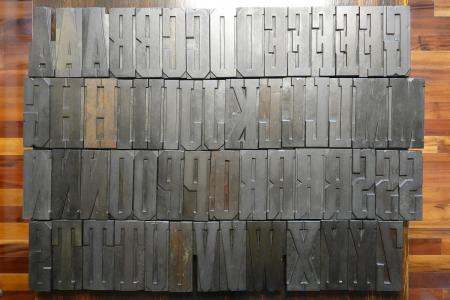
a.jpg
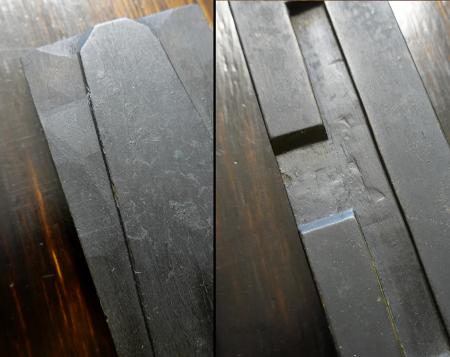
tm.jpg
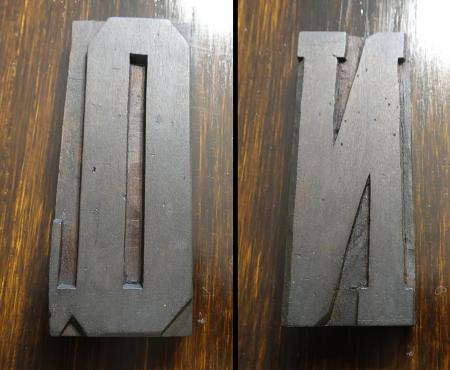
qn.jpg

It was a fairly common practice to cut needed letters on the back of characters not used in a particular job that were of about the same width and the same height, even from a different font, either because more of a character was needed than the font included or because a character that was needed was damaged.
Thanks for this info. I printed some ampersands from this set on dampened postcard stock today using my C&P Pilot press. The size constraint of the card stock cut off a bit of the top and bottom, but I am generally encouraged with the prints. I also printed some full-sized versions on thinner stock.
ampersand.jpg
With any older wood type you can expect variations in the printing height with every form you build. The old Hamilton Wood Type specimen catalogues would declare that their wood type needed no underlayment or other adjustments because they stated that their manufacturing was so accurate that the type would print perfectly all the time. Well, add one hundred years or more to the age of the type and you will have to do some underlayment or other make ready. Use thin stock and build it up slowly. Nice set of type!
Jim
Thank you—this is helpful. I am hoping to eventually purchase a sign press or proofing press to print this type. I can only print a letter or two at a time on my Pilot press.